

Wadi Al Dhahir is a hidden gem trail in Fujairah, UAE, offering turquoise sulphur pools, panoramic mountain views, and a taste of adventure just a short drive from Dubai. This ultimate guide will help you plan an independent hike to Wadi Al Dhahir – covering difficulty level, trailhead access, weather, safety, terrain, time required, parking, what to pack, navigation tips, best season, and driving directions from Dubai – all based on local expertise and up-to-date information. Whether you’re a seasoned hiker or a weekend warrior from Dubai, we’ve got you covered. Read on to discover why Wadi Al Dhahir is worth the trip and trust this guide to prepare you for an unforgettable journey.
Why Hike Wadi Al Dhahir?
Wadi Al Dhahir (also known as Wadi Dahir or the Al Henna “Sulphur” Trail) is often called UAE’s hidden sulphur pools trail, and for good reason. Unlike crowded spots like Rainbow Valley or Wadi Abadilah, Wadi Al Dhahir remains relatively quiet and untouched . Here’s why this trail has become a favorite for weekend hikers from Dubai:
- Sulphur Pools & Scenery: The trail features small crystal-clear sulphur ponds that shimmer turquoise after rains – a rare sight in UAE’s mountains . These pools, found at the start and end of the loop, make the hike uniquely scenic and fun.
- Diverse Terrain: Hikers pass through lush wadi vegetation, hop across rocks around water pools, and even encounter a hidden man-made dam with trees rising from the water . The landscape ranges from green valley floors to Mars-like red-rock hills , offering plenty of variety.
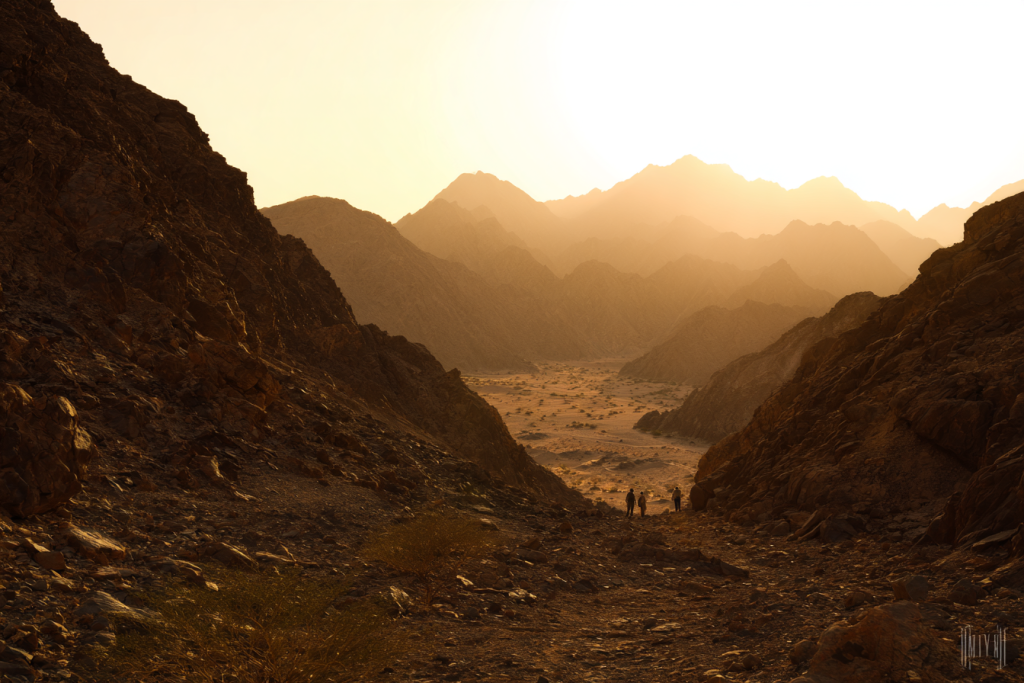
- Panoramic Views: As you gain elevation, you’ll be rewarded with sweeping views of the Hajar Mountains – especially magical at sunset when golden light bathes the peaks . It’s a photographer’s dream and a welcome escape from city life.
- Quiet & Undiscovered: Despite its beauty, Wadi Al Dhahir is less known than other trails, meaning fewer crowds on weekends . You can enjoy a more peaceful, off-the-beaten-path experience, ideal for those seeking tranquility in nature.
- Accessible Adventure: For Dubai residents, Wadi Al Dhahir offers a perfect day trip adventure. It’s challenging enough to be rewarding but not so difficult as to require advanced skills – making it appealing for a broad range of hikers.
In short, Wadi Al Dhahir blends adventure with accessibility. Next, we’ll dive into all the details to help you hike this trail independently and safely, with the confidence of having a seasoned guide in your pocket.
A hidden turquoise sulphur pool in Wadi Al Dhahir. The trail’s small ponds and lush wadi vegetation are a rare treat in the UAE’s arid mountains.
Wadi Al Dhahir Trail Overview
Before lacing up your boots, it helps to know the key facts about the Wadi Al Dhahir hike. Below is a quick overview of the trail’s main features:
| Trail Feature | Details |
|---|---|
| Location | Ḑāhir area, Fujairah, UAE (near Dibba). Approximately 1.5–2 hours’ drive from Dubai. |
| Trail Type | Loop (circular route), well-marked with cairns and painted arrows . |
| Distance | ~8.4 km (5.2 miles) for the full loop . A shorter 3 km out-and-back option is available for a shorter family-friendly hike . |
| Time Required | ~4–5 hours for the full loop (average pace) . Faster hikers can complete it in ~3 hours, while leisurely explorers might take 6 hours. |
| Difficulty | Easy-Moderate (often described as “beginner plus” ). Suitable for hikers with basic fitness; some light rock scrambling around pools. |
| Elevation Gain | ~270 m gain (from ~180 m to 400 m elevation) – mostly gentle inclines with one short steep section near the end. |
| Terrain | Rocky wadi (dry riverbed) with boulders, gravel, and some farm trails. Expect to hop around water pools and possibly get your feet wet. |
| Highlights | Turquoise sulphur pools (ankle to knee deep) , a hidden dam and pond, panoramic mountain vistas, and unique red rock formations. |
| Family/Kids Friendly | Yes – active kids (~10+ years) can handle the easier parts, especially via the shorter 2–3 km route . Supervise children on rocky sections. |
| Dog Friendly | Officially discouraged. While dogs were previously allowed , rangers now advise against bringing pets to avoid disturbing local goats . |
| Mobile Coverage | Limited/None. No mobile signal inside the deeper wadi sections ; signal may return at higher elevations. Download maps offline. |
| Trail Markings | Yes. Stone cairns and yellow-painted arrows guide the way . Still, a keen eye is needed at certain turns (more on navigation tips below). |
| Permits/Fees | None required. Wadi Al Dhahir is free to access – it’s open for public hiking with no entry fee or permit needed. |
This overview shows that Wadi Al Dhahir is an achievable adventure for most weekend hikers. Next, we’ll cover when to go, how to get there, what to pack, and how to stay safe on the trail.
Best Time to Hike Wadi Al Dhahir (Weather & Season)
Wadi Al Dhahir is best hiked in the cooler months. The winter period from late November to early March offers ideal conditions . During these months, daytime temperatures in Fujairah’s mountains are mild (roughly 18–25°C), making the hike comfortable and enjoyable.
- Why Winter? From November through March, you’ll avoid the extreme heat of UAE summers. Cooler weather means you can hike during the day without risking heat exhaustion. This season also sees occasional rain, which replenishes the wadi pools – making the sulphur ponds more vibrant and plentiful .
- Hiking in Hotter Months: If you plan to hike outside the winter window (say in April, October, or even summer), adjust your timing. Start very early in the morning (sunrise) or late in the afternoon (around 4–5 pm) to avoid the midday sun . Keep in mind that there is virtually no shade at midday on the trail , so a midday summer hike can be extremely draining and risky.
- Sunrise/Sunset Hikes: In warmer periods, a dawn hike means you finish before noon, while an evening hike lets you catch the sunset glow on the mountains . Just ensure you carry a headlamp if there’s any chance you’ll still be walking after dark.
- Weather Risks: Always check the weather forecast before heading out. While rain is rare, flash floods are a real danger in UAE wadis. If heavy rain is forecast (especially in winter months), postpone the hike – Wadi Al Dhahir’s riverbed can flood suddenly during downpours. Generally, the trail should be avoided on days of thunderstorms or immediately after major rain unless you have verified it’s safe.
- Year-Round Considerations: Even in winter, midday sun can be strong. Wear sun protection (hat, sunscreen, sunglasses) and reapply sunscreen during the hike. In December and January, mornings can be cool (~10–15°C), so a light jacket or fleece is useful, but by midday you’ll likely be in a t-shirt.
UAE Tip: Remember that Fujairah’s mountain weather can differ from Dubai’s. It might be raining in the Hajar Mountains even if Dubai skies are clear. Always double-check Fujairah/Dibba weather specifically. And if hiking in summer, know that heat and humidity can be intense – plan accordingly, or better yet, save Wadi Al Dhahir for winter and choose an indoor activity in peak summer.
Getting There: Trailhead Access & Driving Directions from Dubai
One of the perks of Wadi Al Dhahir is its accessibility. Despite feeling remote, the trailhead is easy to reach by car. Here’s how to get there and what to expect on the drive from Dubai:
Driving Directions:
From Dubai, plan roughly a 1.5 to 2-hour drive (approximately 130-150 km, depending on your starting point). The route is mostly highway:
- Dubai to Fujairah – Take either E611 (Emirates Road) or E311 (Mohammed Bin Zayed Road) toward Sharjah, then head east on E88 (Al Dhaid Road) towards Masafi. Continue through the mountains towards Dibba.
- Join E87 (Al Shuhada Road) – Near Masafi or after the mountain pass, you’ll connect with E87 heading north towards Dibba. Wadi Al Dhahir is located just off E87.
- Look for Fujairah Adventures Signage – As you approach the Ḑāhir area on E87 (between Masafi and Dibba), keep an eye out for signage or turn-offs for hiking trails. The Wadi Al Dhahir trailhead is marked on Google Maps as “Fujairah Adventures Al Dahir Hiking Trail” . It will be on the left side of the highway if you’re coming from Dubai, so you may need to go a bit further and make a U-turn at a safe point . The exact parking area coordinates are 25.541858, 56.160186 – you can plug this into your GPS or simply search the trail name on Google Maps.
- Final Approach: The last stretch is a short drive off the highway to the parking. The road is paved/gravel and accessible by sedan – a 4×4 is not required. If you’re in a low-clearance car, drive slowly on any gravel portion to avoid rocks, but generally sedans can reach the parking spot with no issues.
Parking:
A dedicated parking area is available near the trailhead, on a gravel patch just off E87 . It’s conveniently up a small hill, right by the start of the hike. On weekends, you might see a few other cars or groups gearing up, but there’s ample space to park safely off the road. There are no official facilities (no toilets or shops), just an open parking spot. Make sure not to block any farm access gates or dirt tracks.
When you park, you’ll likely notice a trail information board or signage put up by Fujairah Adventures. The trail begins a short walk from the parking: head west (towards Dubai direction) along a narrow path. You’ll pass a small green farm on your right as you enter the wadi – that’s how you know you’re on the correct path to the first sulphur pools .
Driving Tip: The drive through the mountains is part of the adventure. Enjoy the scenery, but also plan your timing to avoid traffic bottlenecks (Friday evenings returning to Dubai, for example, can be busy on some highways). Leaving Dubai early on a weekend morning (6–7 AM) usually means a smooth drive with minimal traffic, getting you to the trailhead by 8 or 9 AM. This timing also ensures cooler temperatures during your hike.
What to Pack for Wadi Al Dhahir
Heading into a wadi wilderness requires preparation. Packing the right gear will keep you safe and comfortable on the trail. Here’s a handy checklist of what to bring:
| Gear/Item | Notes |
|---|---|
| Water (3+ liters) | Carry at least 3 liters of water per person . The UAE climate is dry and you’ll sweat more than you realize. No water sources on trail (pools are not for drinking). |
| Sturdy Footwear | Wear proper hiking shoes or boots with good grip . The terrain is rocky and can be slippery near water. Good shoes prevent slips and ankle twists. |
| Backpack | Use a comfortable daypack to hold your supplies. Ideally, use a pack with a water bladder or space for 3L of water for easy sipping on the go . |
| Snacks & Lunch | Pack lightweight energy snacks (dates, protein bars, nuts) and possibly a light lunch. Hiking 4-5 hours burns calories – you’ll appreciate a bite on the trail . |
| Sun Protection | Absolutely bring a hat, sunglasses, and sunscreen (SPF 50+). Apply liberally. There’s no shade midday on the trail , so sun protection is critical. |
| Clothing | Wear lightweight, moisture-wicking clothes. Athletic t-shirts and hiking pants/leggings work well. In winter, pack a light jacket or fleece for cool mornings . Avoid cotton that stays wet. |
| First Aid Kit | A basic first aid kit with band-aids, blister plasters, antiseptic wipes, and any personal medication. Minor scrapes or blisters can happen on rocky ground – be prepared . |
| Navigation Aids | Offline map or GPS device. Download the Wadi Al Dhahir trail on an app like Wikiloc or have a GPS track in a device . Cell signal is weak, so don’t rely on Google Maps once on foot. |
| Light Source | Headlamp or torch – in case your hike runs late or you start pre-dawn. It’s a safety must for any hike, especially if there’s a chance of being out near sunset . |
| Trekking Poles | Optional but useful. Trekking poles can help with balance on uneven rocks and reduce knee strain on descents . If you have sensitive knees or plan a relaxed pace, consider bringing them. |
| Mobile Phone & Power | Bring a fully charged phone (for emergency and photos!) and consider a small power bank . Remember, network is limited, but your phone can serve as a camera/GPS. |
| Extra: Towel or Flip-Flops (optional) | If you plan to wade through pools or in case your boots get soaked, a small quick-dry towel can help, and flip-flops/sandals to change into after the hike will feel comfy. |
Packing these essentials will set you up for a successful hike. It’s better to carry a slightly heavier backpack with what you need than to be caught in the mountains wishing you hadn’t left something in the car. Pro tip: Always double-check your gear the night before. And remember to tell someone (a friend or family member) your hiking plans and expected return time for safety.
On the Trail: Route and What to Expect
Now for the fun part – what the Wadi Al Dhahir hike is actually like! This section walks you through the trail experience from start to finish, so you know what to expect in terms of terrain, landmarks, and challenges.
Trail Start (km 0 – 1): From the parking, as mentioned, you’ll walk a short path by a farm to enter the wadi. The trail is a loop, and we recommend doing it clockwise (starting leftwards into the wadi) to save the best views for the end . Early on, you’ll encounter the first sulphur pools within the initial kilometer . These are small, clear ponds of water often tinged blue-green from mineral content. Take a moment to enjoy them – in cooler months you might see frogs or tiny fish. The water isn’t deep (mostly ankle to calf deep) , so you can step through carefully if needed. Note: The pools might have a faint sulphur smell (like boiled eggs) especially after rain – that’s normal for mineral springs.
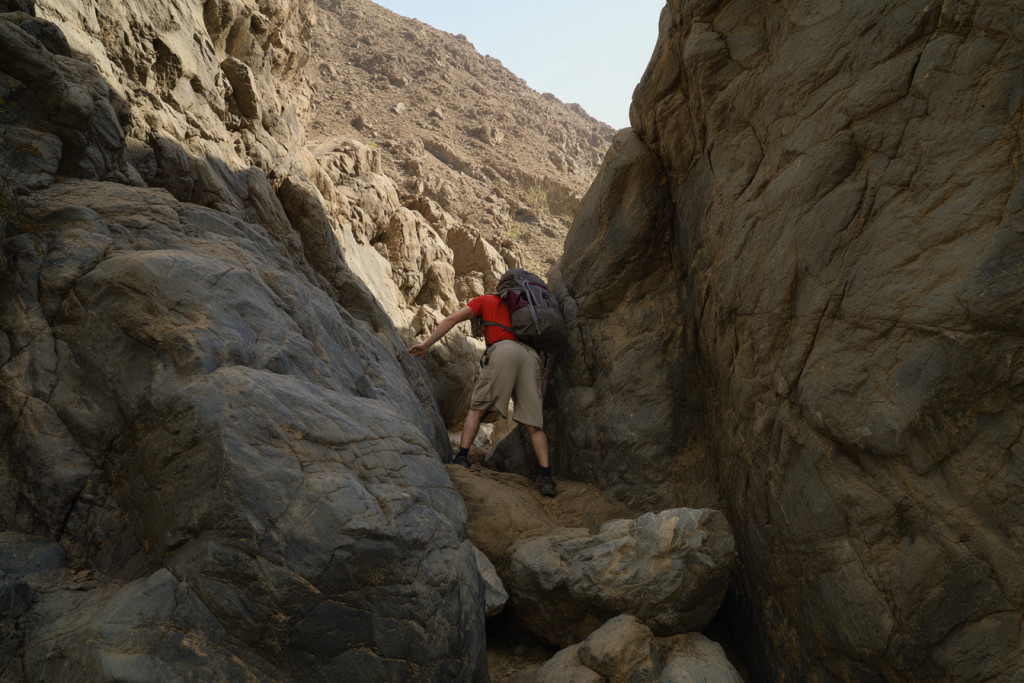
Into the Wadi (km 1 – 4): The trail continues along the wadi floor. You’ll be walking on gravel, sand, and rocks amid the wadi’s winding course. The scenery here is surprisingly green after rains – tamarisk shrubs and desert plants line parts of the wadi, and you might spot the occasional farm terraced into the valley sides. Navigation is straightforward in this section: follow the valley. Cairns (stacks of stones) and yellow painted arrows on larger rocks confirm you’re on track . Whenever in doubt, look for those markers. There are a few instances where large pools block the direct path, and you have two choices: boulder around using hands and feet (a fun mini-scramble) or walk through the water if it’s shallow – either is fine, just take care on slippery rocks . This part is mostly flat with a very gentle incline. Enjoy the high canyon walls and watch for wildlife; goats are common on the cliffs, and you might see birds or dragonflies near the water.
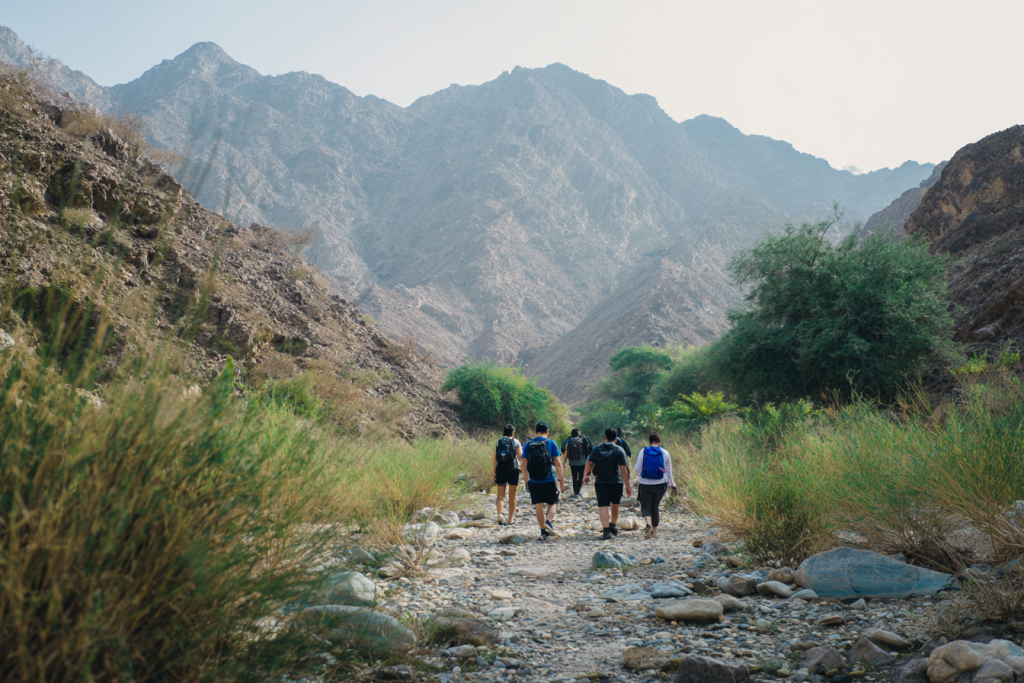
Exploring the rocky wadi of Wadi Al Dhahir. Much of the hike involves walking on a dry riverbed surrounded by towering canyon walls – an exciting change of scenery from the city.
Mid-Trail (km 4 – 6): As you approach the midpoint of the loop, the wadi opens up a bit and the trail gradually ascends. You’re now gaining elevation onto the hillsides. This is where you’ll get the first expansive views of the surrounding Hajar Mountain range behind you. It’s a good spot to take a breather, sip water, and appreciate how far you’ve come. Important Navigation Note: About three-quarters through the hike (roughly around 5.5 km in on the loop), there’s a critical turn. The wadi seems to continue forward, but you actually need to take a short marked climb to the left to stay on the loop . Look out for a large cairn and a yellow arrow pointing left – that indicates the spot to leave the wadi floor and go up a rocky slope through an opening. Missing this turn could lead you into a dead-end part of the wadi, so stay vigilant here. If you do miss it, you might encounter a sudden drop or cliff; simply backtrack and watch for the markers.
Soon after this turn and brief climb, you’ll stumble upon a surprise: a small man-made dam and pond in a side valley . It’s a surreal sight – a few trees emerging from the still water, contrasting against the dry landscape. This is a perfect lunch or snack spot. The area around the dam has a concrete slab/bridge you’ll walk across .
Last Section (km 6 – 8.4): After the dam, you’re on the final stretch heading back toward the trailhead but along a higher route. Another easy-to-miss point: when you cross the concrete dam/bridge, look for steps leading down rightward into the wadi rather than following the obvious straight path . Those steps can be subtle, but going down them puts you on the correct return path. Now the trail descends gradually. This area has short, steep hills – you’ll go up and down a couple of small ridges. It’s a bit of a leg workout but very short-lived. In return, you get the best panoramic views here. If you time it right (late afternoon), the lighting is incredible. You might see the road in the far distance or even your parked car as you come over the last hill.
Finally, the trail drops you back near the start of the wadi, closing the loop near the first pools. Congratulations – you’ve completed the Wadi Al Dhahir hike! Take a final look back at the valley you conquered. Most hikers finish this trail with big smiles, a camera full of unique photos, and a sense of discovery.
Trail Etiquette: As you hike out, remember to carry all your trash back with you. There are no bins out here (and that’s a good thing). Keep Wadi Al Dhahir pristine by practicing Leave No Trace – future hikers will thank you. Also, if you encounter any local farmers or villagers (on rare occasion near the start or end), a friendly wave and greeting in Arabic (“Salam”) goes a long way in maintaining the warm hospitality hikers often experience in the UAE’s rural areas.
Safety & Navigation Tips
Hiking in a remote wadi requires some extra caution, even on a well-marked trail like Wadi Al Dhahir. Here are crucial safety and navigation tips specific to this trail and the UAE environment:
- Limited Phone Signal: As noted, don’t rely on your mobile phone for navigation or calls. No network coverage inside the wadi means you can’t call for help or check Google Maps in many sections . Download an offline map or GPX track of Wadi Al Dhahir beforehand. Apps like Gaia GPS, Wikiloc, or Maps.me can show your location via GPS even without cell service. Consider sharing your live location with someone before you enter the no-signal zone (it might update when you hit a high point with signal).
- Never Hike Alone (if Possible): While solo hiking is not forbidden, it’s safer to have at least one companion on a remote trail. In case of an injury or if you lose the trail, a buddy can make all the difference. If you do go solo, double down on other precautions: tell someone your plan, carry a whistle, maybe even a personal locator beacon if you’re an avid solo adventurer.
- Heat Precautions: Even in winter, UAE sun can dehydrate you quickly. Wear a hat, use sunscreen, and drink water regularly (sip don’t chug). By the time you feel thirsty, you’re already a bit dehydrated. A good rule is to drink ~250 ml every 20-30 minutes of active hiking. Also include some electrolytes (sports drink or rehydration salts) if you’re out for many hours.
- Flash Flood Awareness: We mentioned it before but it bears repeating – avoid wadis if heavy rain is in the forecast. Wadi Al Dhahir’s trail largely follows the valley floor, which is a flood path for rainwater. Even distant rain in the mountains can send a flash flood downstream. Check the forecast for Dibba or Masafi area. If you hear sudden roaring water or see storm clouds, move to higher ground immediately or better, turn around and exit if safe to do so.
- Trail Markers: Generally, Wadi Al Dhahir is well-marked (thanks to Fujairah Adventures) with stone cairns and painted arrows . Still, pay attention at junctions or spots where the wadi splits. If you haven’t seen a marker in a while and the path seems unclear, you might have deviated – backtrack to the last known marker. Avoid creating new paths or shortcutting, as it can damage the environment and mislead others.
- Terrain Hazards: You will encounter loose rocks and possibly slippery wet stones near pools. Test your footing before committing your weight, especially when hopping between boulders. Take your time on the two short steep sections – there’s no rush, and using your hands for balance (or a trekking pole) can prevent slips.
- Wildlife: There’s no dangerous wildlife particular to Wadi Al Dhahir, but you might see goats (belonging to local farmers) or harmless reptiles. In the cooler season, snakes are very rare but possible in rocky areas – they typically avoid humans. Just watch where you place hands and feet when scrambling. Do not approach or feed any animals, and they won’t bother you.
- Respecting the Locale: The trail is in a natural area that is also used by local communities (farms and goat herders). Be respectful: don’t pick fruit from farms, don’t disturb animals, and keep noise levels reasonable. We want to ensure hikers are welcome visitors, not a nuisance.
- Emergency Numbers: As part of preparedness, note that the emergency number in UAE is 999 (police) or 998 (ambulance). Though you likely won’t have signal in the wadi, you might climb to a higher point if you needed to call. It’s also wise to carry Rafeeg Travel’s contact (for guided hike participants) in case you need advice – you can reach them at +971567333331 if you have reception (or before your trip for any last-minute questions).
By following these safety tips, you’ll greatly reduce any risks and ensure your Wadi Al Dhahir adventure is as enjoyable as it is memorable. Now that we’ve covered independent hiking thoroughly, let’s look at how a guided trip can enhance your experience, and why Rafeeg Travel is a name you can trust.
Guided vs. Independent Hiking (and How Rafeeg Travel Helps)
Hiking Wadi Al Dhahir on your own is certainly doable and rewarding, but you might also be considering joining a guided hike. Both options have their merits, and it often comes down to personal preference and experience level. Here’s a quick comparison, and an introduction to what Rafeeg Travel offers for Wadi Al Dhahir hikers:
Independent Hiking: Going solo or with friends means freedom – you set your schedule, pace, and can turn it into a private adventure. It’s cost-effective and builds your outdoor self-reliance. This guide has hopefully given you the confidence to tackle Wadi Al Dhahir independently. If you’re an experienced hiker with navigation skills, you’ll likely have no issue.
However, independent hiking requires you to be fully prepared – you’re responsible for navigation, safety, and emergency planning. If something goes wrong, help is not immediately on hand. First-timers to UAE’s wadis might feel more comfortable with an expert until they know the ropes.
Guided Hiking: Joining a guided group (such as those organized by Rafeeg Travel) can enrich your experience. You get the knowledge of a local guide, the safety net of someone who knows the route intimately, and often some extras like nature insights or photography tips. It’s also social – you meet fellow hikers and enjoy a group camaraderie which can be great fun on a weekend outing.
Why Rafeeg Travel Stands Out:
Rafeeg Travel is a UAE-based adventure company specializing in hiking trips, and they’ve built a strong reputation among outdoor enthusiasts. Here’s why they shine:
- Expertise & Safety: Rafeeg’s guides are certified in Wilderness First Aid and have deep knowledge of local trails. They always carry proper first aid kits and emergency communication. This expertise ensures that your safety is the top priority, and any unforeseen situations (injuries, sudden weather changes) are handled calmly and professionally. Hikers often comment on feeling very safe and well-cared-for with Rafeeg.
- Local Knowledge: The team is led by passionate Emirati and resident guides who know Wadi Al Dhahir and other trails like the back of their hand. They’ll show you hidden spots (like the best angle to view the sulphur pools, or a quiet nook for sunset) that you might miss on your own. They also share insights about the geology, flora, and fauna, turning the hike into an educational experience.
- Convenience: Rafeeg Travel takes care of the logistics. From start to finish, everything is seamless – they organize meeting points or transport, provide any needed gear (often trekking poles or headlamps if you forget yours), and handle all the planning . “All we had to do was show up and enjoy the hike,” says one client. This is perfect if you don’t want the hassle of route-finding or worrying about every detail.
- Community & Camaraderie: When you join a Rafeeg hike, you’re also joining a community. The hikes are group-friendly, making it easy to socialize. Many Dubai weekend hikers have made new friends on Rafeeg trips. The guides foster a supportive atmosphere where everyone from beginners to experienced hikers feel welcome. One nervous first-timer shared:
“I was a bit nervous as a beginner, but Rafeeg Travel’s guides made it easy and enjoyable. The trails were stunning, and the experience was well-suited for all skill levels.” – Emily, Dubai
- Credibility & Trust: With over 1,000+ positive reviews and a 4.9/5 rating online, Rafeeg Travel has earned trust in the community . They’ve been featured in local media and are known for professionalism. Many hikers are repeat customers. Here’s what a few have said:
“From start to finish, everything was seamless. The team at Rafeeg Travel handled all the logistics, so we just focused on enjoying the hike. Highly recommend!” – Ahmed, UAE
“Rafeeg Travel made my first hiking experience unforgettable! The guides were knowledgeable and made everyone feel safe and comfortable. I can’t wait for the next adventure!” – Sarah, UAE
These testimonials highlight Rafeeg’s commitment to quality. It’s not about pushing a service; it’s about enhancing your hiking experience with guidance and care.
- Extras: Rafeeg often provides little extras on their hikes – perhaps a trail snack pack, group photos, or celebratory karak tea at the end! They also organize hikes across UAE and Oman, so once you’ve hiked with them, you might be inspired to join future trips (beaches, camping, other wadis, etc.).
Importantly, Rafeeg Travel isn’t here to pressure you into guided trips. They fully support independent hikers (after all, they even share guides like this one). But if you ever feel like trying a guided hike for convenience or learning, Rafeeg is a top-notch choice. For Wadi Al Dhahir, they occasionally run group hikes – sometimes as affordable as ~100 AED per person, which is great value for the experience. You can always reach out to them at +971567333331 to check upcoming hike schedules or ask any questions. They’re happy to help, whether you hike with them or on your own.
FAQs: Wadi Al Dhahir Hiking Trail
Below you’ll find answers to common questions about hiking Wadi Al Dhahir. Each FAQ is crafted to address specific concerns or curiosity you might have before hitting this trail.
Q: What is Wadi Al Dhahir and where is it located?
A: Wadi Al Dhahir is a scenic wadi (valley) hiking trail in the Hajar Mountains of Fujairah, UAE, known for its sulphur pools and mountain views. It’s located in the Ḑāhir area of Fujairah, roughly a 1.5 to 2-hour drive northeast of Dubai, near the town of Dibba. In essence, Wadi Al Dhahir is a hidden gem hiking spot that offers a refreshing nature escape from the city.
Q: How far is Wadi Al Dhahir from Dubai and how do I get there?
A: Wadi Al Dhahir is about 130–150 km from Dubai, depending on your starting point (roughly near Downtown Dubai). By car, it takes about 1.5 to 2 hours to reach. You’ll drive towards Fujairah (via Al Dhaid or Sharjah), then take the E87 highway toward Dibba. The trailhead is just off E87, marked as “Fujairah Adventures Al Dahir Hiking Trail” on Google Maps . There’s a parking area near the trail. Unfortunately, there’s no public transport directly to the wadi – driving or joining a group tour is the way to go.
Q: How long is the Wadi Al Dhahir hike and how much time does it take?
A: The full Wadi Al Dhahir loop is about 8.4 km long . For an average hiker, it takes around 4 to 5 hours to complete, including short breaks. Faster hikers can do it in ~3 hours, while photographers or families taking it easy might spend up to 6 hours. If you choose the shorter out-and-back option (~3 km each way) to just see the pools and return, that can be done in about 2 hours .
Q: What is the difficulty level of the Wadi Al Dhahir trail?
A: Wadi Al Dhahir is generally rated easy to moderate. Some call it “beginner plus” difficulty . That means it’s suitable for beginners who have done at least one or two hikes before. The path is mostly flat wadi walking with a few short climbs. There are no technical climbing sections – just a bit of rock hopping. As long as you have basic fitness (able to walk 4-5 hours with rests) and decent balance, you should manage fine. Total elevation gain is around 250–300 m, which is quite manageable spread over the distance.
Q: What kind of terrain and scenery can I expect on the Wadi Al Dhahir hike?
A: The terrain is a mix of rocky wadi (dry riverbed), dirt trails, and some hillside paths. You’ll walk on gravel, sand, and rocks. In some spots you’ll scramble gently over rocks to bypass water pools. The scenery is diverse: you’ll see turquoise sulphur pools, palm trees and green shrubs in the wadi, towering reddish-brown canyon walls, and open views of jagged mountains as you ascend. One highlight is a small man-made dam and lake hidden in the mountains. The variety – from narrow canyon to open mountain vistas – is what makes Wadi Al Dhahir special.
Q: When is the best time of year to hike Wadi Al Dhahir?
A: The best time is winter and early spring (late November through March) . During these months, temperatures are cool to mild, ideal for hiking. You’ll also find water in the wadi (pools) after winter rains. Outside of this window, you can hike in October or April with an early start. Avoid the peak summer (June–August) unless you are very experienced with desert heat and start at dawn – temperatures can exceed 40°C which is unsafe for hiking. Always check weather forecasts for rain in the cooler months due to flash flood risk.
Q: Can I hike Wadi Al Dhahir in summer?
A: Technically yes, but it’s not recommended. Summer in the UAE (especially July-August) is extremely hot and humid. If you’re determined to do Wadi Al Dhahir in warmer months, go in early morning (start by 5-6 AM) and finish by 9 AM, or hike at sunset (starting around 5 PM, finishing in the dark with a headlamp). Even then, you must carry extra water and be cautious of heat exhaustion. Most hikers simply take a break from wadis in summer and resume in cooler months. The best approach is to wait until at least October, or take advantage of winter when the weather is perfect for hiking.
Q: Is Wadi Al Dhahir suitable for beginners or families with kids?
A: Yes, Wadi Al Dhahir is beginner-friendly and can be family-friendly with some considerations. If you’re a beginner in average shape, you can complete the hike – just be ready for a bit of rock scrambling. Families with active kids (around 10 years or older) have done this trail successfully. In fact, there is a shorter ~3 km route that many families opt for , where you go partway to enjoy the pools and then turn back the same way. Young kids (under 7) might find the full loop too long and some boulders too high, so use your judgment. Always supervise children closely around water and edges. Overall, many consider Wadi Al Dhahir a great “first big hike” for newcomers because it’s exciting but not too hard.
Q: Do I need a guide to hike Wadi Al Dhahir, or can I do it independently?
A: You can absolutely hike Wadi Al Dhahir independently – the trail is well-marked and many people do it on their own . A guide is not strictly necessary . However, if it’s your first time hiking in the UAE or you prefer extra safety, hiring a guide or joining a guided group (like one by Rafeeg Travel) is a great idea. Guides will handle navigation and share interesting info about the area, which can enhance the experience. For confident hikers with navigation tools, going without a guide is fine. For those who are unsure or just want a carefree day, a guided hike removes any stress.
Q: Is the Wadi Al Dhahir trail marked or easy to navigate?
A: Yes, the trail is quite well-marked. You’ll find stone cairns (stacks) and yellow arrows painted on rocks at intervals . These markers are placed by local adventurers/Fujairah authorities to guide hikers. For most of the hike, you just follow the wadi and these signs. There are two specific turns that are easy to miss (as noted in our guide above – one where you climb out of the wadi, and one after the dam). As long as you’re paying attention to the markers at those junctures, you’ll stay on track. It’s always wise to carry an offline map or GPS just in case, but many have done it successfully just following the arrows and cairns.
Q: What should I pack for the Wadi Al Dhahir hike?
A: Key items to pack include 3+ liters of water (no water on the trail), sturdy hiking shoes with good grip, a hat and sunscreen (the sun is strong, no shade at midday), and some energy-boosting snacks (nuts, energy bars, etc.). A basic first aid kit for blisters or scrapes is recommended, as well as an offline map or GPS since phone signal is weak. Don’t forget a fully charged phone or camera for photos – the scenery is gorgeous! Optional nice-to-haves: trekking poles (for stability), a light jacket if hiking in early morning winter, and a headlamp if there’s any chance of finishing near dark. Our packing checklist table above in this guide provides more detail on each item.
Q: Is there mobile network coverage at Wadi Al Dhahir?
A: Not really. Mobile coverage is patchy – expect to have no signal inside the deeper parts of the wadi . You might catch a weak signal on higher ground or near the trail start, depending on your provider (Etisalat often has slightly better remote coverage than Du, but in the canyon there’s generally no service). Because of this, you can’t rely on calling or using data during most of the hike. Plan accordingly: download maps offline and let someone know your plan in advance. Once you’re back near the highway, your phone will likely ping back to life.
Q: Are there any facilities or services near the Wadi Al Dhahir trail?
A: No, there are no facilities at the trailhead or on the trail. This is pure nature – no toilets, no changing rooms, no shops. The nearest facilities would be in towns like Masafi or Dibba. Masafi (famous for its Friday Market) has petrol stations, small supermarkets, and eateries, and it’s about 20-30 minutes drive from the trail. Dibba has restaurants and shops as well. It’s a good idea to use a restroom at a petrol station on the way and stock up on any last-minute supplies in those towns. Ensure you have everything you need (water, food, hat, etc.) before leaving the main road.
Q: Are there any fees or permits required for hiking Wadi Al Dhahir?
A: No, no fees or permits are required. Wadi Al Dhahir is open to the public. You can park and hike without any tickets or permissions. Just respect the area and local regulations (for example, don’t camp or make fires unless you have checked it’s allowed, and don’t litter). It’s always good to leave these places cleaner than you found them to keep them free and accessible.
Q: Can I camp overnight at Wadi Al Dhahir?
A: Officially, there’s no designated campsite at Wadi Al Dhahir, but experienced campers sometimes do wilderness camp in the area. If you plan to camp, you should be well-versed in desert camping and have appropriate gear. You’d need to camp away from farms and paths, and ensure you leave no trace. Be cautious: the wadi could flood if it rains at night, so camping on higher ground is essential. Also note, it can get quite dark and eerie at night in a canyon, and temperatures can drop in winter nights. Unless you’re an experienced camper, it’s probably better to enjoy Wadi Al Dhahir as a day hike and camp at more established spots (like nearby beach camping in Dibba or official camping areas in Fujairah).
Q: What are the sulphur pools in Wadi Al Dhahir? Can I swim in them?
A: The sulphur pools are natural spring-fed pools with a bluish tint due to mineral (sulphur) content, giving the trail its nickname “Sulphur Hike”. These pools are mostly shallow (ankle to knee deep) . You can certainly wade in or dip your feet to cool off. Some hikers like to splash water on their face or just enjoy the cool touch – it’s very refreshing especially on a warm day. Full-on swimming isn’t really possible because they aren’t that deep, and some pools are quite small. Also, because the water is still, it’s not the most hygienic for swimming (algae or frogs might be present). Treat it as a fun nature feature to observe and maybe soak your feet, rather than a swimming hole. And please avoid using soaps or detergents in the water – keep it natural and clean.
Q: Is Wadi Al Dhahir safe?
A: Generally, yes – Wadi Al Dhahir is considered a safe hike as long as you take standard precautions. There are no big cliffs you’ll be walking along (so low risk of falls from height), and no dangerous animals known in the area. The main safety factors are environmental: heat, dehydration, and navigation. We’ve covered these: bring enough water, avoid the hottest part of the day, watch your footing on rocky terrain, and keep track of the trail markers. Another aspect is flash floods – avoid hiking if rain is expected, which is a universal rule for wadis. If you do that, the hike is as safe as any. Also, ensure your fitness level matches the trail – if 8 km of rocky ground sounds daunting, do the shorter option or train a bit beforehand. Always listen to your body and don’t overexert. If something doesn’t feel right (like dizziness from heat), stop and address it early. With good preparation, Wadi Al Dhahir is a very safe adventure.
Q: Is Wadi Al Dhahir dog-friendly?
A: This has changed recently. Dogs were previously allowed (and you might still see references online saying it’s dog-friendly) . However, as of early 2024, local rangers have discouraged bringing dogs to Wadi Al Dhahir . The reason given is that dogs’ scents were disturbing local farm goats and wildlife. It’s not a formal ban, but out of respect for the local community, it’s best to leave your dog at home for this one. If you do bring a pet, ensure it’s leashed and under control, and of course clean up after it. But to be on the safe side and culturally sensitive, consider other hikes that are clearly dog-friendly instead.
Q: How does Wadi Al Dhahir compare to other hikes like Rainbow Valley or Wadi Abadilah?
A: Wadi Al Dhahir offers a mix of features that some other popular hikes have singly. For instance, Rainbow Valley (also in the region) is known for colorful rocks but has no water; Wadi Abadilah has water streams and farms. Wadi Al Dhahir has the mineral pools (like Wadi Abadilah’s water) plus colorful rock landscapes (somewhat like Rainbow Valley) . It’s also quieter than those famous trails – Rainbow Valley can get quite crowded on weekends, whereas Wadi Al Dhahir still feels more secluded. Difficulty-wise, all three are in a similar range (easy-moderate). If you enjoy one, you’ll likely enjoy the others. Many hikers actually rank Wadi Al Dhahir as a favorite because of the surprise elements (sulphur pools, dam) and the varied scenery packed into a half-day hike.
Q: Do I need a 4×4 to reach the Wadi Al Dhahir trailhead?
A: No, a 4×4 is not needed. The trailhead parking is just off a major highway (E87) and is accessible by normal sedan cars. The turn-off and short track to the parking area are dirt/gravel but relatively smooth. Just drive slowly to avoid any bumps. Many people drive compact cars there without issues. Of course, if you have a 4×4, it doesn’t hurt, but it’s by no means required. Save your off-roading for other adventures – Wadi Al Dhahir’s access road is straightforward.
Q: What are the GPS coordinates for the Wadi Al Dhahir trailhead?
A: The parking and trailhead can be pinpointed with these coordinates: 25.541858, 56.160186 . If you plug that into Google Maps or any GPS device, it will direct you to the exact starting point. Additionally, you can search for “Fujairah Adventures Al Dahir Hiking Trails” on Google Maps, which is the labeled location of the trail. It’s always a good idea to have an offline map or screenshot of the map in case signal drops when you’re nearing the area.
Q: What should I do with my trash during the hike?
A: Carry it out with you. There are no bins on the trail, and leaving trash (even biodegradable stuff like orange peels) is a big no-no as it can harm wildlife and spoil the natural beauty. Pack a small trash bag in your backpack. All wrappers, bottles, etc., should go back in your bag and be disposed of properly once you’re back in civilization. Keeping Wadi Al Dhahir clean ensures that it remains open and beautiful for everyone. As hikers, it’s our responsibility to leave no trace.
Q: Can I join a guided hike to Wadi Al Dhahir? What does Rafeeg Travel offer?
A: Yes, you can join a guided hike! Rafeeg Travel organizes guided hikes to Wadi Al Dhahir and many other trails in the UAE. On a guided Wadi Al Dhahir trip with Rafeeg, you’ll be led by a certified, experienced guide who knows the trail intimately. They typically provide guidance, ensure the group’s pace is comfortable for everyone, and share interesting facts about the area. Rafeeg Travel stands out for its safety-first approach (guides with first aid training ), friendly atmosphere, and hassle-free logistics. Essentially, they make the hike accessible to anyone – even if you don’t have a car or much hiking experience. All you need to do is show up with basic gear and they handle the rest (sometimes even including transportation or carpool options from Dubai). It’s a great way to experience Wadi Al Dhahir if you prefer not to go alone. You can contact Rafeeg Travel at +971567333331 to inquire about the next Wadi Al Dhahir trip or any other adventures they offer.
With these FAQs, we hope all your questions about Wadi Al Dhahir hiking are answered. This guide is designed to ensure you feel 100% prepared and excited to tackle the trail. Whether you choose to venture out on your own or with Rafeeg Travel’s supportive group, Wadi Al Dhahir is bound to be a highlight of your UAE outdoor explorations. Happy hiking!